





(21.28 € HT)
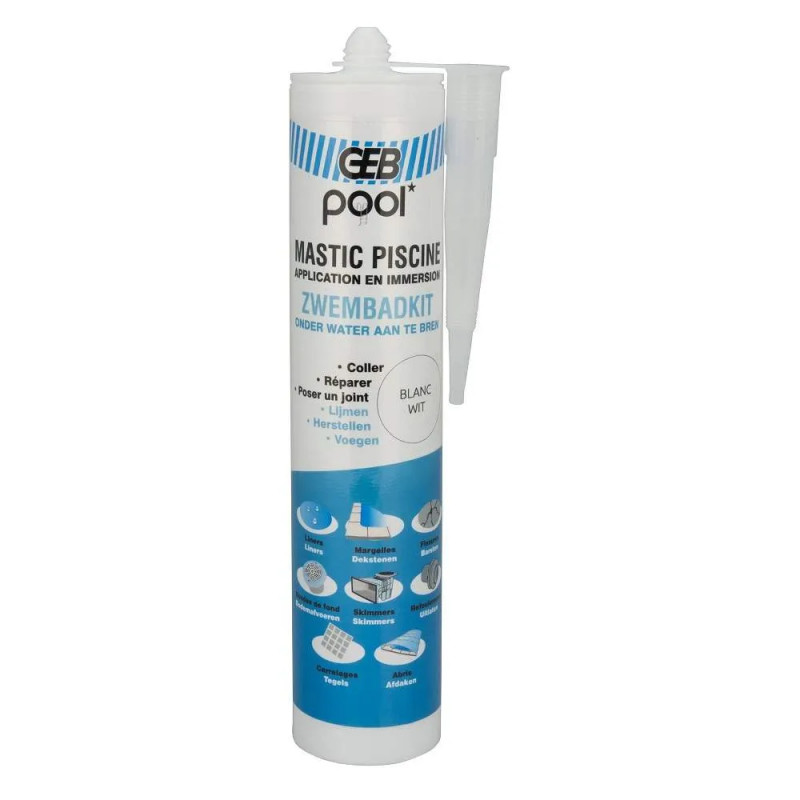
GEB maintenance products. Pool sealant, 290ml cartridge reference 590910.
 Safety guarantees
 Delivery policy
 Returns policy
* Making waterproof seals (skimmers, lights, jets, coping stones, verandas, shelters, ..), floor and expansion joints.
* Fixing tiles, mosaics, friezes, and other decorative elements.
* Repairing leaks on rigid structures and liners (with or without patch). Given the diversity of liners, perform a preliminary test
Very high performance
Applicable underwater.
All substrates.
Resistant to treated pool water.
Color: white.
High initial adhesion.
Cures under the action of air humidity, on wet surfaces and even directly underwater.
Adheres perfectly to most common building and pool materials (except PE, PP PA, PTFE, and bitumen). Resistant to treated pool water, UV, and weather. Not afraid of frost or high heat (temperature resistance from -40°C to +90°C).
Making a seal:
For joints that are too deep, limit the depth with cellular foam.
Cut the end of the nozzle to a diameter slightly smaller than that of the joint.
Ensure maximum contact between the sealant and the joint lips by applying pressure on the bead surface.
Smooth no later than 5 minutes after application.
Making a bond:
For plastic surfaces, it is preferable to remove the "gloss" of the surface to be bonded by slight abrasion with the POOL* ABRASIVE BAND.
Apply the product in spaced linear beads or spots covering the entire surface to be bonded and avoiding large thicknesses. On flat surfaces, 2 mm diameter beads are adequate (nozzle not cut).
Place the object to be fixed by pressing firmly. In most cases, bracing is not necessary.
In immersion:
In the case of a seal or repair, smooth immediately.
For bonding, coat, if possible, the surfaces to be bonded out of the water and apply them by pressing firmly underwater.
Data sheet
Specific References
No customer reviews for the moment.
GEB maintenance products. Pool sealant, 290ml cartridge reference 590910.
(21.28 € HT)